
4 min read

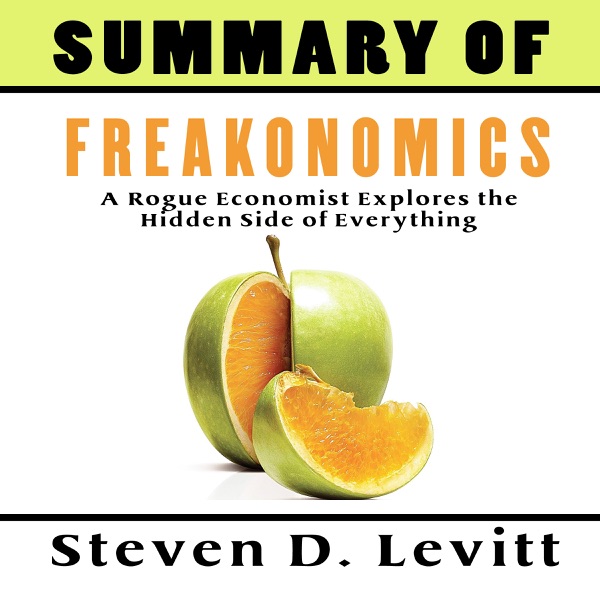
What do a child’s name, the inner workings of a crime drop, and the hidden incentives behind everyday behavior all have in common? In Freakonomics, economist Steven D. Levitt teams up with journalist Stephen J. Dubner to show that economics, at its core, is the study of how people get what they want. The result is a curious, contrarian tour through the hidden side of everything.
Get the Freakonomics Audiobook on AmazonListen on Audible · also in Kindle & printWhat Freakonomics is about
Freakonomics applies the tools of economics to questions most economists never bother to ask. Rather than focusing on markets and money, Levitt treats economics as a way of looking at the world, using data to test what people assume to be true and often arriving at surprising, counterintuitive conclusions. Across a series of loosely connected chapters, the book explores how incentives shape behavior, why conventional wisdom is so frequently wrong, and how distant events and hidden causes can ripple into outcomes no one expects.
Written in plain, conversational language, it favors curiosity over jargon and storytelling over formulas. Dubner’s narrative touch turns Levitt’s research into a series of puzzles, each built around a provocative question and answered with evidence rather than opinion. The goal isn’t a single grand theory but a new way of thinking, one that asks you to question assumptions and follow the data wherever it leads.
| Author | Steven D. Levitt and Stephen J. Dubner |
|---|
Why Freakonomics is great on audio
The Freakonomics audiobook suits the material well, since the book is built around conversational storytelling and provocative questions rather than charts or equations you need to see on the page. The brisk, anecdote-driven chapters are easy to follow while commuting, walking, or doing chores, and the back-and-forth between research and narrative keeps the pace lively. If you enjoy nonfiction that feels more like an engaging conversation than a lecture, it translates naturally to listening.
Who should listen
This one is for curious listeners who love having their assumptions challenged and enjoy popular nonfiction about behavior, data, and human nature. Fans of smart, accessible books that make you rethink everyday questions will find a lot to chew on. Listeners hoping for a structured economics textbook, formal financial advice, or a single linear argument may find its loose, topic-hopping format less satisfying.
If you like Freakonomics, listen to these next
- Atomic Habits by James Clear
- Rich Dad Poor Dad by Robert Kiyosaki
- Think and Grow Rich by Napoleon Hill
How to listen to Freakonomics
Freakonomics is available on Audible and Amazon. If you’re new to Audible you can listen with a free trial, or buy the audiobook (also in Kindle and print) on Amazon.
Get the Freakonomics Audiobook on AmazonListen on Audible · also in Kindle & printFrequently asked questions
What kind of book is Freakonomics?
It is a popular nonfiction title that applies economic thinking to everyday questions about incentives and human behavior. It reads as accessible, story-driven nonfiction rather than a technical economics textbook, which is why many readers place it on the self-help and business shelf.
Do I need a background in economics to enjoy it?
Not at all. The authors deliberately avoid jargon and formulas, explaining their ideas through stories and plain-language reasoning. If you are simply curious about why people behave the way they do, you have everything you need to follow along.
How can I listen to the Freakonomics audiobook?
It is available on Audible and Amazon. If you are new to Audible, you can start with a free trial and use it to begin listening, or you can buy the audiobook outright on Amazon.
Is Freakonomics a single continuous argument or a collection of topics?
It is structured as a series of loosely connected explorations, each built around a different provocative question. They share a common way of thinking rather than a single linear storyline, so you can enjoy each topic on its own while picking up the bigger approach along the way.